Airborne dust, exhaust fumes, and fine particulate can quietly accumulate in warehouse and storage environments, putting worker health and safety at risk.
Without proper air filtration, employees may face respiratory irritation, reduced visibility, and prolonged exposure to contaminants generated by forklifts, loading docks, packaging materials, and high traffic. Removing these airborne hazards helps protect your workforce, improve comfort during long shifts, and create a safer, more productive facility.
By reducing airborne dust, smoke, and fine particulate, you help protect worker health, improve visibility, and minimize respiratory strain during demanding shifts. When your air is managed properly, your workforce can operate more efficiently and confidently every day.
With proper unit placement, our systems exchange the air in your building 8-10 times per hour — reducing particulate by up to 99.7% with every pass, in a space that usually has no air treatment at all.
Forklifts, loading docks, packaging, and high traffic feed the same air your team breathes all shift — quietly, until irritation and reduced visibility show up on the floor. Talk to us about removing it.
Talk to our teamFour sources account for most of what your team breathes across a shift. None of them announce themselves.
Propane and diesel lifts put fine combustion particulate into the air on every run. In a sealed building it doesn't disperse — it circulates.
Open dock doors bring in road grit and field dust. Tire wear and constant traffic keep re-suspending whatever has already settled on the floor.
Cutting cases, breaking pallets, and handling cardboard release paper fiber continuously — the contaminant most warehouses never think to name.
Haze in the aisles slows picking and affects lift safety. Sustained exposure shows up as irritation, fatigue, and complaints late in the shift.
None of these sources announces itself. Dust and exhaust build gradually through a shift, and the first sign is usually a person — irritation, haze in the aisles, fatigue late in the day. Removing the airborne load protects your workforce, improves comfort across long shifts, and makes for a safer, more productive facility.
A note on exhaust gases: filtration captures the particulate fraction of forklift exhaust and carbon stages address odor, but carbon monoxide and other combustion gases are controlled by ventilation rate and equipment maintenance, not by filter media. Air cleaners work alongside your ventilation strategy here — they don't replace it. Our team can help you plan around both.
CleanLeaf and Blue Ox units hang from the ceiling or structure and operate as standalone systems — no ductwork, and no HVAC required. In buildings that were never designed for air treatment, they're often the only filtration present.
Units work together to create a circular air pattern through the building. As air flows through the high-efficiency filters, particulate is reduced by up to 99.7% per pass — then handed off to the next unit, which reduces it further.
This cycle continues until the space reaches a clean air standard, with the air exchanging up to 8-10 times per hour depending on your configuration.
Warehouses are mostly air. High ceilings and open spans mean coverage per unit matters more than it does in a small room, which is why this application usually starts with high-CFM equipment rather than adding units in every corner. Mounting height also changes how far a unit throws, so it factors directly into spacing.
Placement makes the difference. Units positioned near dock doors and main traffic lanes intercept contamination where it enters and where it's stirred up, rather than waiting for it to spread through the racks. Key factors include cubic footage, ceiling height, lift traffic, dock activity, and shift length.
Each unit has a specific catch and throw distance that determines optimal spacing. Our team can help you design the right configuration for your building.
Units cycle air up to 8-10× per hour, running through quiet periods as well as peak activity — so what a shift stirs up gets removed rather than left to circulate into the next one.
Large volumes and high ceilings mean airflow and throw distance drive the selection. All models use standard-sized high-efficiency filters to keep running costs low.
For open warehouse floors, racking aisles, and receiving areas where traffic and dock dust are the primary load — the most common starting point for distribution facilities.
T-pattern airflow covering a wide span from a single mounting point.
Explore OX3000
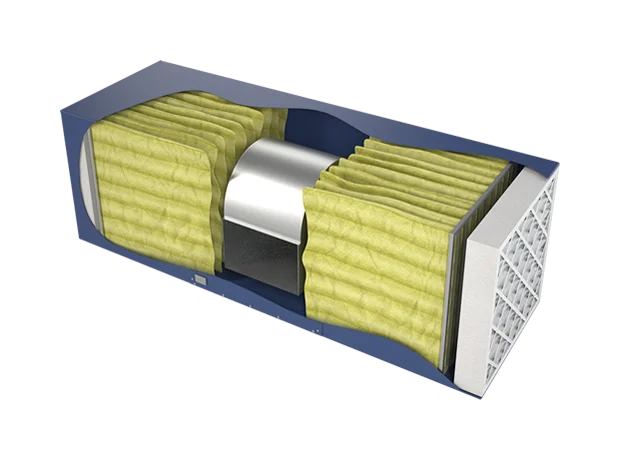
The practical starting point for most warehouse floors. Its T-style airflow pattern draws through inlets on both sides and exhausts from the center, covering a wide footprint from one mounting point — which matters when you're trying to treat an open span without hanging equipment every thirty feet. A dual set of micro-glass fiber filters extends service intervals under steady traffic dust.
Ultra high-capacity air cleaning for large contaminated spaces.
Explore OX7000
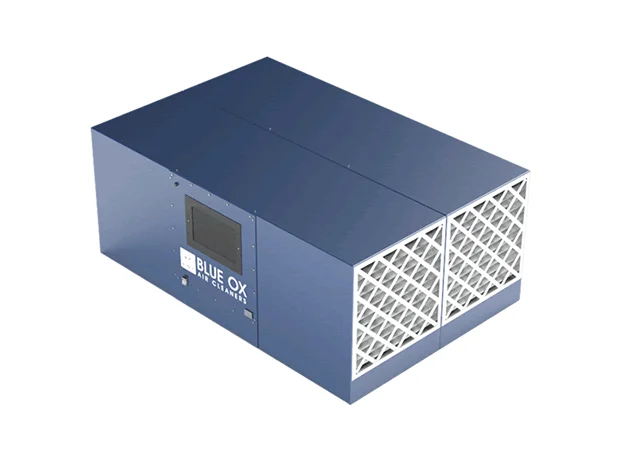
Distribution centers hold enough air that reaching a useful number of exchanges with mid-size equipment means a lot of units. At 7,000 CFM, the OX7000 does the work of several — the right answer for high-bay buildings, large open floors, and facilities running lift traffic across multiple shifts. The OX4000, OX4500, and belt-driven OX3500C fill the range between.
For buildings running propane or diesel lifts, or storing materials that carry their own smell into the working space.
Industrial carbon after-filtration for smoke and odor reduction.
Explore OX3500C-CF
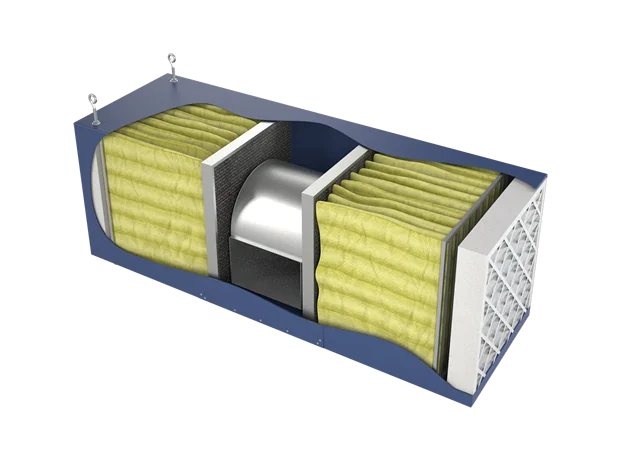
A belt-driven industrial platform with carbon after-filtration, built for buildings where lift exhaust is a constant rather than an occasional. The particulate stages handle combustion soot and traffic dust while the carbon stage works on the smell that staff notice first — and complain about most.
High-volume carbon filtration for smoke and odor in defined areas.
Explore OX2500D-CF
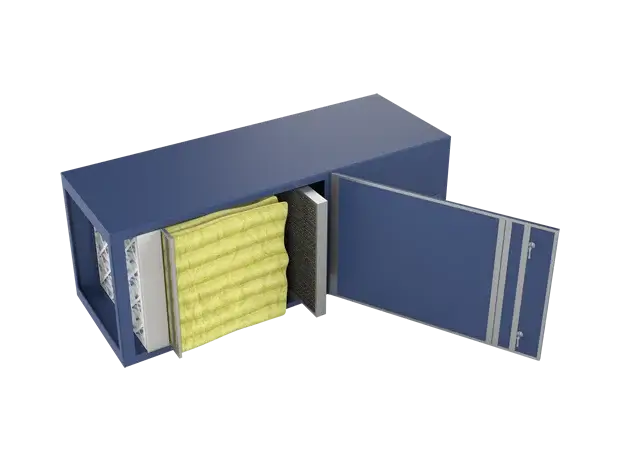
Not every part of a warehouse needs a 3,500 CFM industrial unit. Receiving bays, staging areas, and enclosed sections next to the dock are where exhaust and dust concentrate most, and a targeted unit sized to that zone is often the more sensible spend than treating the whole building to the same standard.
For offices, break rooms, QC desks, and temporary work zones inside the building — spaces where people sit still while the floor moves around them.
Portable room filtration for flexible placement and quick deployment.
Explore CL400
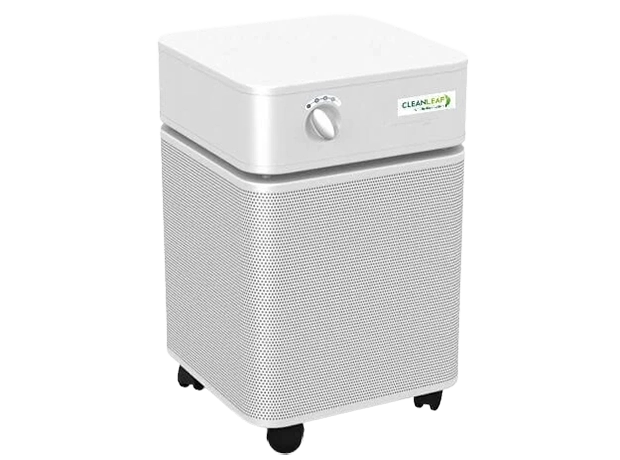
Warehouse offices, break rooms, and QC stations sit inside the same building envelope as the dock, but the people in them stay put for hours. A portable unit treats those spaces without a mounting project, and moves when the work does — useful during seasonal peaks or while a temporary staging area is running.
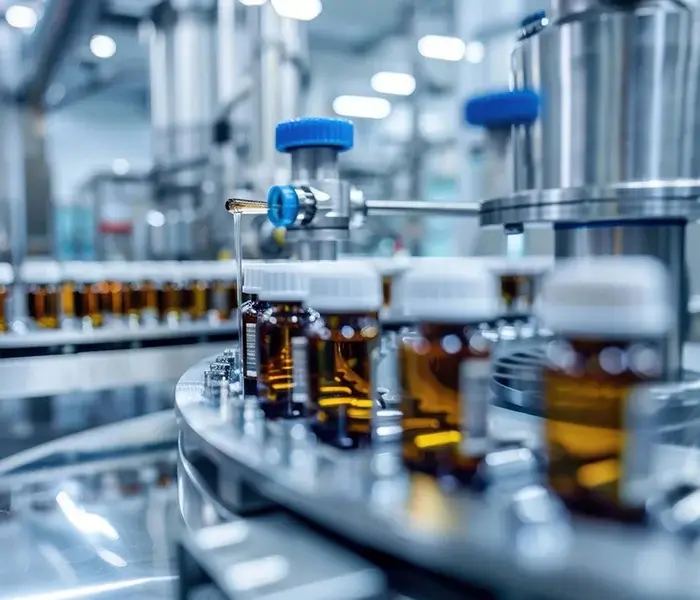
Warehousing is one part of the operation. CleanLeaf covers air quality across manufacturing and woodshop environments too.
Powder, particulate, and process odor control for pharmaceutical, food, beverage, and cosmetic production — protecting product integrity and compliance.
Explore NowAirborne wood dust capture beyond source collection — protecting respiratory health, visibility, and equipment across the shop floor.
Explore NowFind quick answers to the most common questions about our services, solutions, and process.
See All FAQsAir filtration system selection depends on:
• Room size (cubic footage)
• Air changes per hour (ACH)
• Type of contaminants (dust, smoke, mold, odors, VOCs)
• Required filtration level (bag filter %, carbon weight, HEPA, etc.)
Our team evaluates airflow dynamics and contaminant load to recommend a properly sized solution — not just a box with a fan.
Most CleanLeaf and Blue Ox models operate between ~48–66 dBA, depending on airflow setting and unit size.
Lower-speed settings and optional silencers are available for sound-sensitive environments.
Most units are plug-and-play on standard 115V power and include suspension or bracket mounting options.
For larger commercial or industrial applications, we may recommend airflow planning to optimize circulation patterns.
Filter life varies by environment and contaminant load. Typical ranges:
• Pre-filters: 1–3 months
• Carbon media: 6–12 months
• HEPA or high-efficiency bags: 6–18 months
Higher particulate or odor loads may shorten intervals.
Our systems are engineered to capture and control:
• Dust
• Smoke
• Mold and Mildew
• Odors and VOCs
• Fine particulate
Filtration stages may include pleated pre-filters, high-efficiency bag filters, HEPA media, and activated carbon depending on the application.
CleanLeaf offers a 2-year warranty covering defects in materials and workmanship for authorized distributors and end users.
To make a claim, you must get approval first. Approved claims are resolved with a replacement or credit/refund. The warranty is void if the product was misused or used outside its intended purpose.
We also provide ongoing support and access to replacement filters.
If you would like to speak with one of our product experts about our products, pricing, or to get a system estimate, please call or email us using the contact information below. If you want pricing for a specific product or would like to be contacted by a product expert, please use the Request a Quote Form. If you need support with an existing order, please visit the Contact Us page.
Please share a few details below, and a product expert will contact you promptly. To accelerate the process, please provide as much detail about our application as possible (EX: type of contaminant (dust, odor, fumes...), size of your space, ceiling height...).