In pharmaceutical, food, beverage, and cosmetic manufacturing, airborne contaminants aren't just an inconvenience — they're a compliance and product integrity risk.
Uncontrolled dust, fine particulate, and airborne pollutants can compromise sterile environments, contaminate products, and expose employees to unnecessary respiratory hazards.
In powder-handling operations, the contaminant is often the product itself. Active ingredients, pigments, flour, and excipients don't stay where they're dosed — they go airborne at every transfer, weigh-out, and blend, then settle wherever the air carries them.
CleanLeaf units remove industrial-level contaminants, providing you and your team with cleaner air and a more effective production environment that upholds high standards of quality and safety.
With proper unit placement, our systems exchange the air in your space 8-10 times per hour — reducing particulate by up to 99.7% with every pass until your room is performing at its best.
A Granite Transformations facility struggled with hazardous silica dust and strong epoxy odors that previous solutions couldn't fix. See how the OX3000 handled both.
Read the full case studyFour contaminant types show up across regulated manufacturing. Each one calls for a different filtration stage.
Active ingredients, pigments, flour, and excipients go airborne at every weigh-out, transfer, and blend — and settle wherever the room's air carries them.
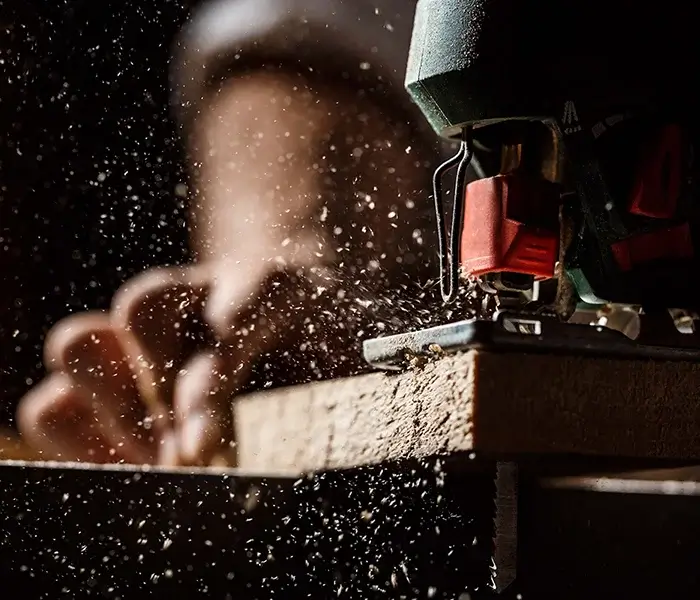
Cutting, grinding, milling, and finishing throw fine particulate that stays suspended long after the operation stops — silica and metal dust among the most hazardous.
Epoxies, solvents, coatings, and curing agents release compounds that linger in enclosed production areas and drive worker complaints.
Residual airborne material from one run reaching the next is a batch record problem, not a housekeeping one — and it's the hardest kind to trace after the fact.
Line clearance assumes the room is clean when the next batch starts. Anything still suspended from the previous run settles onto equipment and product after the wipe-down is signed off — which is why airborne load between batches matters as much as the cleaning procedure itself.
CleanLeaf and Blue Ox units hang from the ceiling or structure and run independently of your HVAC — no ductwork, and no interference with existing make-up air, pressurization, or process exhaust.
Units work together to create a circular air pattern through the space, much like supply and return vents in an HVAC system. As air flows through the high-efficiency filters, particulate is reduced by up to 99.7% per pass — then handed off to the next unit, which reduces it further.
This cycle continues until the room reaches a clean air standard, with the air exchanging up to 8-10 times per hour depending on your configuration.
Ambient capture complements source capture. Hoods, downdraft tables, and local extraction catch what they're aimed at. What escapes the capture zone becomes room air — and stays there until something removes it. Ceiling units address that fraction rather than replacing your existing collection.
Where sterile conditions or product integrity are the driver, HEPA configurations capture 99.97% of particles at 0.3 microns. Where solvents and coatings are in play, carbon stages can be added to the same unit.
Placement makes the difference. Units positioned to establish a continuous circular pattern pull air away from work surfaces rather than pushing it across them. Key factors include cubic footage, ceiling height, particulate load, equipment layout, and your target air quality standard.
Units cycle air up to 8-10× per hour — cleaning the same air repeatedly. Sound levels run roughly 48–66 dBA depending on model and speed setting, with optional silencers for sound-sensitive areas.
Choose based on your primary contaminant and the cubic footage you need to turn over. All models use standard-sized high-efficiency filters to keep running costs low.
For production floors, fabrication areas, and powder-handling rooms where airborne particulate is the primary concern — the most common starting point in manufacturing.
High-capacity air cleaner with T-pattern airflow for dust and smoke control.
Explore OX3000
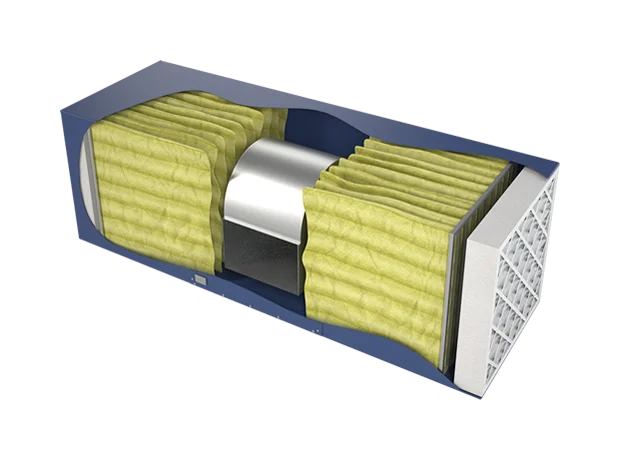
The workhorse for a single production area. A dual set of micro-glass fiber filters provides substantially more filter area than a single-filter unit, and the T-style airflow pattern draws through inlets on both sides while exhausting from the center — covering a wide work area from one mounting point. This is the unit that resolved silica dust and epoxy odor at Granite Transformations after other approaches had failed.
Heavy-duty industrial filtration for dust, mist, and smoke applications.
Explore OX4500
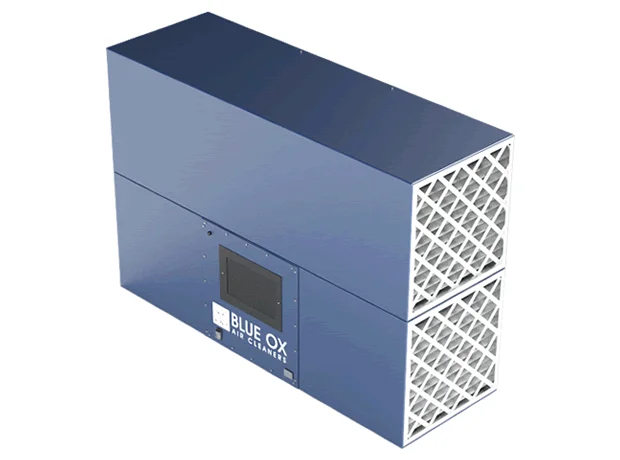
When the contaminant load is continuous and the space is large, the OX4500 delivers half again the airflow of the OX3000. Built for demanding industrial duty including oil mist and smoke alongside dust, it's the right call for machining halls, fabrication bays, and processes running through full shifts. For spaces beyond its reach, the OX7000 extends the same approach to 7,000 CFM.
For pharmaceutical, food, beverage, and cosmetic rooms where microbial counts, sterile conditions, or documented air standards are part of the requirement.
HEPA-led platform for particle and pathogen reduction at volume.
Explore OX2500D-HE
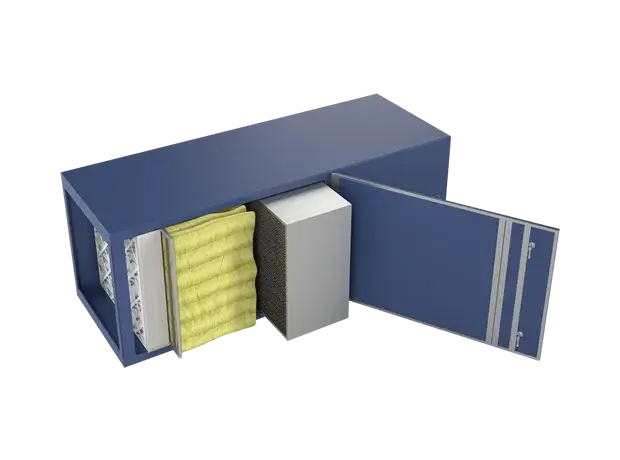
Where the tolerance for airborne contamination drops, a HEPA final stage captures 99.97% of particles at 0.3 microns — the range where mold spores, bacteria-carrying particulate, and the finest process dust travel. Delivered at 2,000 CFM, it reaches useful air-change rates across a full production room rather than a single bench.
Carbon + HEPA for combined odor control and pathogen protection.
Explore CL2500D-CCPHE
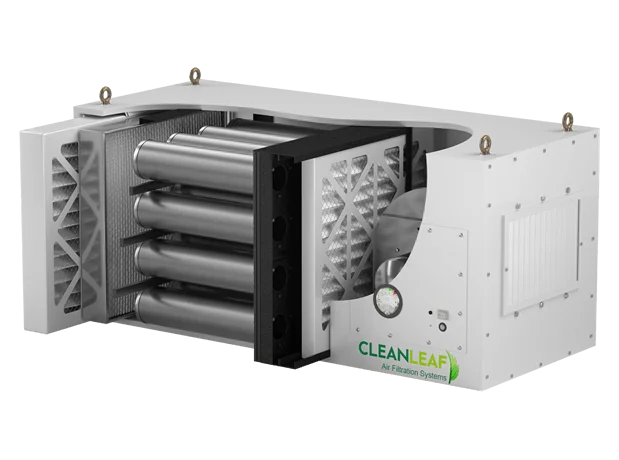
Regulated production rooms rarely have a single problem. This configuration stacks a carbon stage ahead of HEPA media, so solvent and process odor and airborne particulate are handled in the same pass. The ductable form factor helps in rooms where equipment layout limits where a unit can hang.
For areas running epoxies, solvents, coatings, and curing agents where odor is the complaint driving the conversation.
Carbon after-filtration for smoke and light odor at high airflow.
Explore OX3000-CF
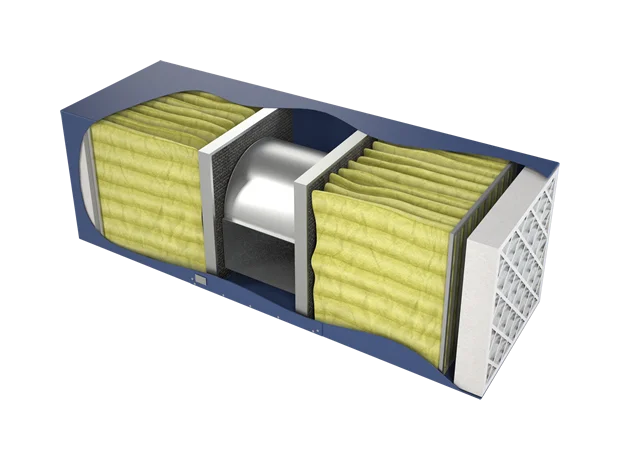
The OX3000 platform with a carbon after-filter added, so particulate capture and odor reduction happen in the same pass at full airflow. This is the configuration for finishing areas, coating lines, and any room where the dust problem and the smell problem arrived together. For heavier odor loads, carbon canister builds like the OX2500D-CC and CL2500-CFP carry substantially more media.
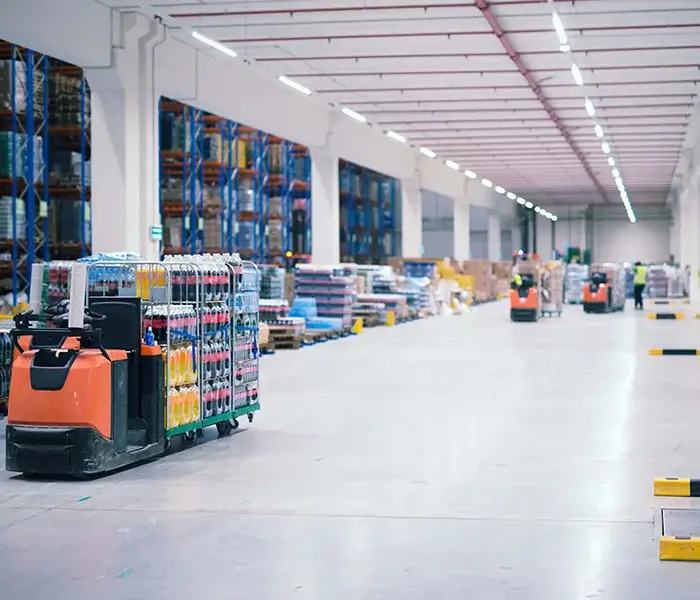
Manufacturing is one part of the operation. CleanLeaf covers air quality across warehousing and woodshop environments too.
Forklift exhaust, dock dust, and packaging particulate control for warehouse and storage environments — protecting worker health across long shifts.
Explore NowAirborne wood dust capture beyond source collection — protecting respiratory health, visibility, and equipment across the shop floor.
Explore NowFind quick answers to the most common questions about our services, solutions, and process.
See All FAQsAir filtration system selection depends on:
• Room size (cubic footage)
• Air changes per hour (ACH)
• Type of contaminants (dust, smoke, mold, odors, VOCs)
• Required filtration level (bag filter %, carbon weight, HEPA, etc.)
Our team evaluates airflow dynamics and contaminant load to recommend a properly sized solution — not just a box with a fan.
Most CleanLeaf and Blue Ox models operate between ~48–66 dBA, depending on airflow setting and unit size.
Lower-speed settings and optional silencers are available for sound-sensitive environments.
Most units are plug-and-play on standard 115V power and include suspension or bracket mounting options.
For larger commercial or industrial applications, we may recommend airflow planning to optimize circulation patterns.
Filter life varies by environment and contaminant load. Typical ranges:
• Pre-filters: 1–3 months
• Carbon media: 6–12 months
• HEPA or high-efficiency bags: 6–18 months
Higher particulate or odor loads may shorten intervals.
Our systems are engineered to capture and control:
• Dust
• Smoke
• Mold and Mildew
• Odors and VOCs
• Fine particulate
Filtration stages may include pleated pre-filters, high-efficiency bag filters, HEPA media, and activated carbon depending on the application.
CleanLeaf offers a 2-year warranty covering defects in materials and workmanship for authorized distributors and end users.
To make a claim, you must get approval first. Approved claims are resolved with a replacement or credit/refund. The warranty is void if the product was misused or used outside its intended purpose.
We also provide ongoing support and access to replacement filters.
If you would like to speak with one of our product experts about our products, pricing, or to get a system estimate, please call or email us using the contact information below. If you want pricing for a specific product or would like to be contacted by a product expert, please use the Request a Quote Form. If you need support with an existing order, please visit the Contact Us page.
Please share a few details below, and a product expert will contact you promptly. To accelerate the process, please provide as much detail about our application as possible (EX: type of contaminant (dust, odor, fumes...), size of your space, ceiling height...).