Dust, dander, ammonia, and odor buildup in enclosed barns can stress animals, impact respiratory health, reduce yields, and create an uncomfortable environment for workers.
Enclosed housing concentrates everything. Feed dust, bedding particles, dander, and manure gases accumulate in a space that's deliberately sealed against the weather — and the tighter the building, the higher the load.
CleanLeaf systems actively reduce airborne particulates and odor-related contaminants, improving air quality for livestock and staff — supporting healthier animals and higher yields through a more controlled environment.
With proper unit placement, our systems exchange the air in your building 8-10 times per hour — reducing particulate by up to 99.7% with every pass, without exhausting the heat you're paying to keep inside.
Winter ventilation forces a trade between air quality and heating cost. Recirculating filtration removes dust and odor from air you've already conditioned — so you can stop choosing.
Talk to our teamFour contaminants accumulate wherever animals are housed under roof. Each affects animals and staff differently.
Dry feed handling, bedding changes, and animal movement put fine organic dust into the air continuously — the single largest airborne load in most enclosed housing.
Animal dander stays suspended for long periods and acts as a carrier — bacteria and endotoxin travel through a building attached to dust rather than on their own.
Manure gases concentrate fastest in cold months when ventilation is dialed back to hold heat — exactly when animals spend the most time indoors.
Sustained dust and gas exposure strains respiratory function in animals and workers alike. Stressed animals convert feed less efficiently and produce less.
Much of what makes barn air hard on lungs travels attached to particulate rather than freely in the air. Pulling dust and dander out of circulation removes the vehicle — which is why particulate control does more for respiratory conditions than its name suggests.
A note on ammonia: ammonia is a gas, and gas concentration is governed primarily by manure management and ventilation rate. Filtration reduces the dust and odor-carrying particulate that accompanies it, and carbon stages address odor compounds in the air. Talk to our team about your building's ventilation design so we can recommend a configuration that works alongside it.
CleanLeaf barn air cleaners hang from the ceiling or structure and run independently of your ventilation system — no ductwork, and no interference with existing fans, inlets, or curtain controls.
Units work together to create a circular air pattern through the building. As air flows through the high-efficiency micro-glass filters, particulate is reduced by up to 99.7% per pass — then handed off to the next unit, which reduces it further.
This cycle continues until the space reaches a clean air standard, with the air exchanging up to 8-10 times per hour depending on your configuration.
The recirculating advantage matters most in winter. Exhaust ventilation improves air quality by throwing conditioned air outside and pulling cold air in. Recirculating filtration cleans the air already in the building — so you can reduce dust and odor during the months when ventilation rates are lowest and contaminant levels are highest.
Placement makes the difference. Units positioned to establish a continuous circular pattern maximize coverage across pens and alleys. Key factors include building size and ceiling height, animal density, bedding and feed handling practices, and your existing ventilation design.
Each unit has a specific catch and throw distance that determines optimal spacing. Our team can help you design the right configuration for your building.
Units cycle air up to 8-10× per hour — cleaning the same air repeatedly rather than exhausting it. Heat, humidity, and the cost of conditioning all stay in the building.
Enclosed housing means large volumes and heavy dust loads, so most operations start with high-CFM units. All models use standard-sized high-efficiency filters to keep running costs low.
For barns, poultry houses, and animal holding areas where feed dust, bedding particles, and dander are the primary load — the most common starting point for enclosed housing.
High-CFM dust capture sized for the air volume of a typical enclosed barn.
Explore OX2500D
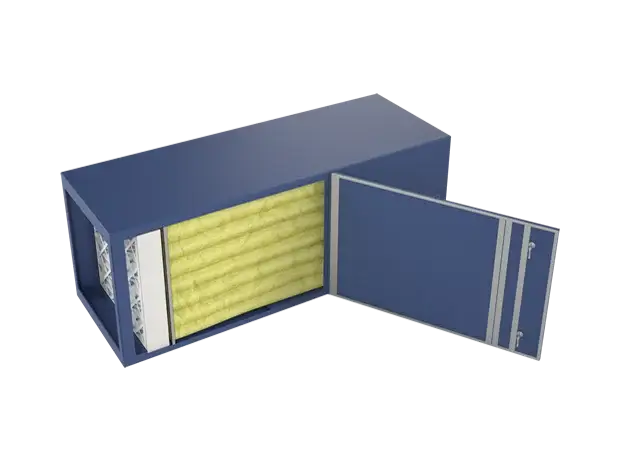
The working baseline for enclosed housing. Barns hold far more air than a processing room, so reaching a useful number of air changes takes volume — and the OX2500D delivers it while devoting full filter area to particulate. The washable foam pre-filter takes the heavy organic dust load that would otherwise blind the bag filter early.
Dual micro-glass filters and T-pattern airflow for the heaviest dust loads.
Explore OX3000
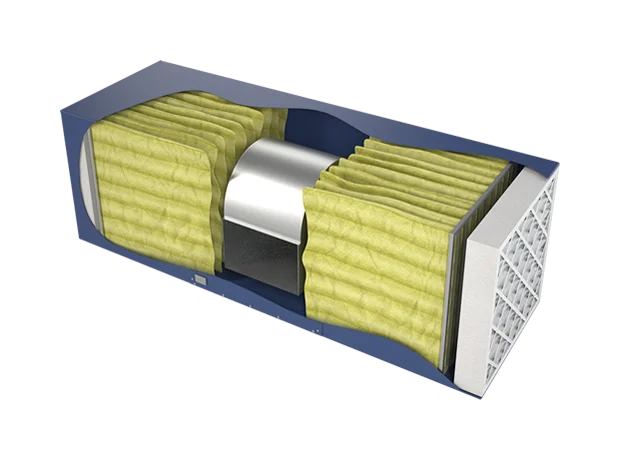
For high-density housing and large open buildings where dust is generated around the clock. A dual set of micro-glass fiber filters provides substantially more filter area, extending service intervals under loads that would exhaust a single-filter unit quickly. Its T-style airflow pattern draws through inlets on both sides and exhausts from the center, covering a wide span from a single mounting point.
For tightly enclosed buildings where odor concentrates alongside dust — and for operations where odor carries beyond the property line.
High-CFM particulate capture with a carbon stage for odor control.
Explore OX2500D-CF
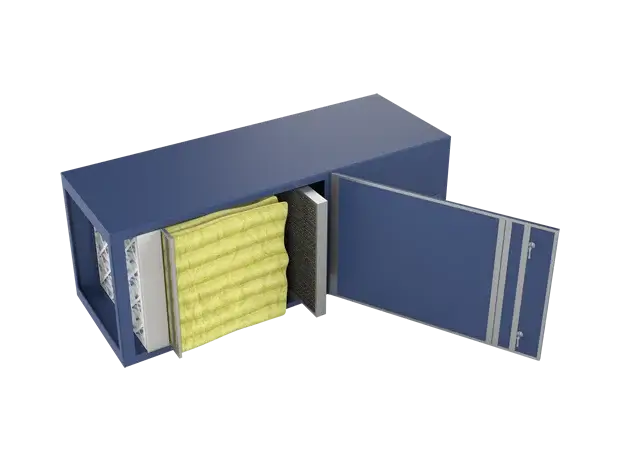
Odor in enclosed housing builds through the day and peaks in the months when ventilation is lowest. This configuration pairs high-volume particulate capture with a carbon stage, addressing the dust that carries odor and the odor compounds themselves in a single pass — useful where neighbors, staff comfort, or buyer walkthroughs make odor a business issue.
Compact carbon build for milking parlors, nurseries, and staff areas.
Explore OX1100-CF
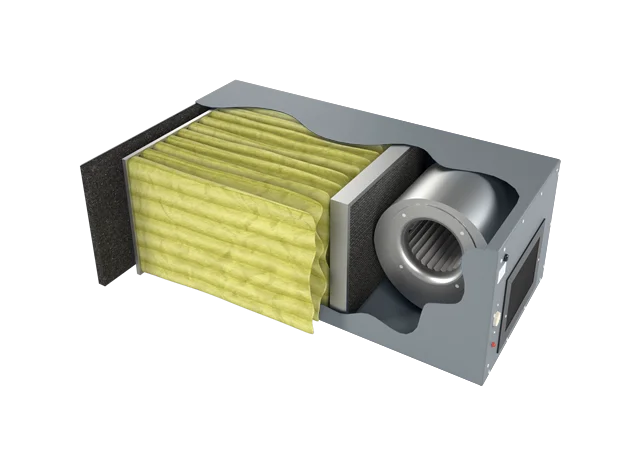
Not every space in an operation is a full barn. Milking parlors, nursery rooms, feed prep areas, and staff break rooms are smaller, occupied by people for long stretches, and often the first place odor gets noticed. A shortened bag filter makes room for a 6 lb. carbon after-filter in a unit sized to the room.
For nurseries, farrowing rooms, isolation areas, and breeding stock housing where airborne pathogen load carries the highest cost.
HEPA-led build for the rooms where airborne pathogen load matters most.
Explore OX1100-HE
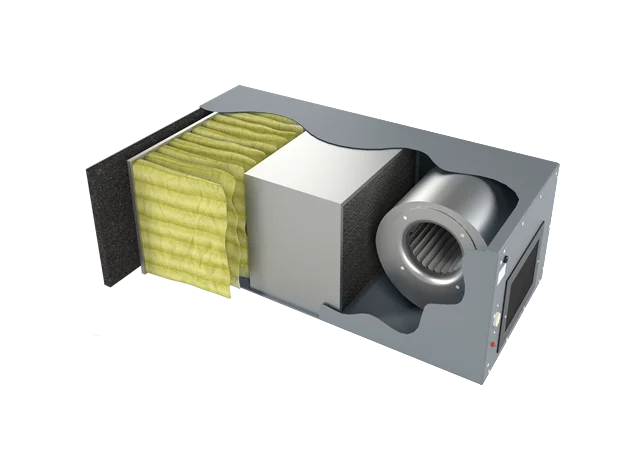
Young and immunocompromised animals carry the highest per-head cost when respiratory illness moves through a room. A HEPA stage captures 99.97% of particles at 0.3 microns — the size range where bacteria-carrying dust and mold spores travel — making it the right choice for nurseries, farrowing, isolation, and breeding stock rather than open housing.
Livestock housing is one part of the operation. CleanLeaf covers air quality across growing, processing, and storage environments too.
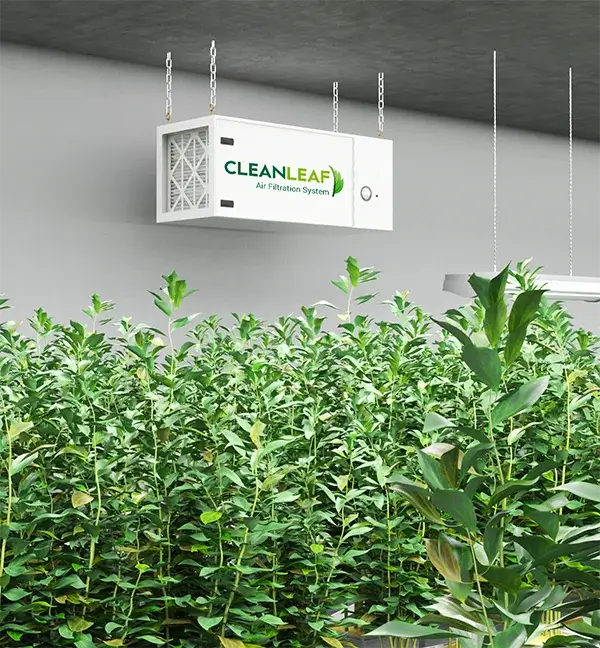
Mold, powdery mildew, and dust control for controlled grow environments — protecting plant vitality and yield potential.
Explore NowSorting, trimming, and packaging areas where dust and fibers threaten product integrity and regulatory air standards.
Explore NowProtect seed, feed, and sensitive agricultural inputs from airborne dust and cross-contamination during storage.
Explore NowFind quick answers to the most common questions about our services, solutions, and process.
See All FAQsAir filtration system selection depends on:
• Room size (cubic footage)
• Air changes per hour (ACH)
• Type of contaminants (dust, smoke, mold, odors, VOCs)
• Required filtration level (bag filter %, carbon weight, HEPA, etc.)
Our team evaluates airflow dynamics and contaminant load to recommend a properly sized solution — not just a box with a fan.
Most CleanLeaf and Blue Ox models operate between ~48–66 dBA, depending on airflow setting and unit size.
Lower-speed settings and optional silencers are available for sound-sensitive environments.
Most units are plug-and-play on standard 115V power and include suspension or bracket mounting options.
For larger commercial or industrial applications, we may recommend airflow planning to optimize circulation patterns.
Filter life varies by environment and contaminant load. Typical ranges:
• Pre-filters: 1–3 months
• Carbon media: 6–12 months
• HEPA or high-efficiency bags: 6–18 months
Higher particulate or odor loads may shorten intervals.
Our systems are engineered to capture and control:
• Dust
• Smoke
• Mold and Mildew
• Odors and VOCs
• Fine particulate
Filtration stages may include pleated pre-filters, high-efficiency bag filters, HEPA media, and activated carbon depending on the application.
CleanLeaf offers a 2-year warranty covering defects in materials and workmanship for authorized distributors and end users.
To make a claim, you must get approval first. Approved claims are resolved with a replacement or credit/refund. The warranty is void if the product was misused or used outside its intended purpose.
We also provide ongoing support and access to replacement filters.
If you would like to speak with one of our product experts about our products, pricing, or to get a system estimate, please call or email us using the contact information below. If you want pricing for a specific product or would like to be contacted by a product expert, please use the Request a Quote Form. If you need support with an existing order, please visit the Contact Us page.
Please share a few details below, and a product expert will contact you promptly. To accelerate the process, please provide as much detail about our application as possible (EX: type of contaminant (dust, odor, fumes...), size of your space, ceiling height...).